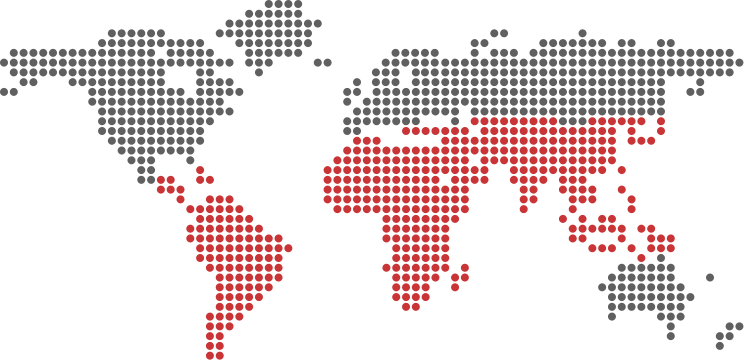
In Nepal, and in many contexts like it, daily challenges are stark: doctors diagnosing patients with limited imaging equipment, startups building without venture capital, governments trying to digitize services with inconsistent infrastructure.
These aren't edge cases. For most of the world, these are the problems.
This is the reality of most low- and middle-income countries, representing 85% of the world population.
While the challenges seemed daunting, the founders recognized that no single initiative could address systemic problems of this magnitude. Each had left home in pursuit of intellectual growth, yet could not abandon the persistent tug to create change where they came from.
“We need a research institute that is neither a university nor a private college, that will be autonomous and bring impact through its own research efforts. We need to keep moving with plans and help people (especially youths) by educating them and giving a vision that we have now.”
From these reflections emerged NAAMII, built around three interlocking pillars:
This integrated approach has guided NAAMII's evolution from an ambitious idea to a multifaceted organization.

Today, NAAMII’s work spans multiple fields including healthcare, NLP, agriculture, robotics, virtual exploration, and drug resistance, with interventions extending to pilot programs, rural health clinics, classrooms, and international conferences.
This triad creates more than an organization, building scientific sovereignty, where local needs are driving research agendas without compromising international standards of rigor.
As one founder articulated the deeper motivation:
“For any rational mind, thinking, worrying, or blaming has no meaning. Acting, in any way possible, is the only way to show you truly care. I want NAAMII to be a symbol that we care, and to set an example for dreamers, even in tough circumstances.”
NAAMII, meaning ‘well-known’ in Nepali, embodies our commitment to bringing visibility to overlooked problems and demonstrating what’s possible in low-resource settings. We seek recognition not for ourselves, but for the solutions that emerge when scientific excellence meets real-world constraints, and for the hope that rigorous research can thrive anywhere.