Semi-Supervised Semantic Image Segmentation
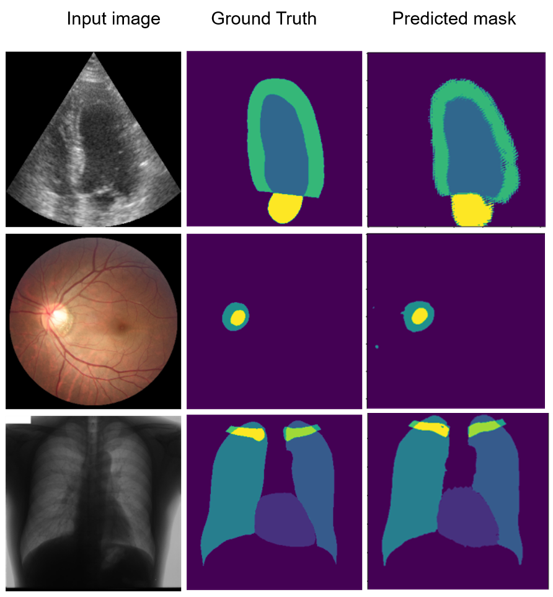
This project advances biomedical imaging by enabling effective semantic segmentation with limited labeled data, reducing annotation costs and accelerating AI adoption in global health.
While supervised deep learning excels in image tasks with large annotated datasets, it underperforms in domains like biomedical imaging where annotated labels are scarce. Although semi-supervised learning shows promise in image classification, it has not achieved comparable success in semantic segmentation due to the laborious nature of data annotation for this task.
Our goal is to advance semi-supervised semantic segmentation to achieve performance close to fully supervised methods. By exploring novel regularization techniques and augmentation strategies, the goal was to improve learning from limited labeled data while maintaining robust performance in biomedical imaging tasks.
This project developed semi-supervised semantic segmentation techniques specifically tailored for biomedical imaging. Novel regularization and augmentation strategies were explored and implemented, improving model performance with limited labeled data. These methods provide a foundation for cost-effective, scalable AI tools in global health applications where large annotated datasets are impractical.